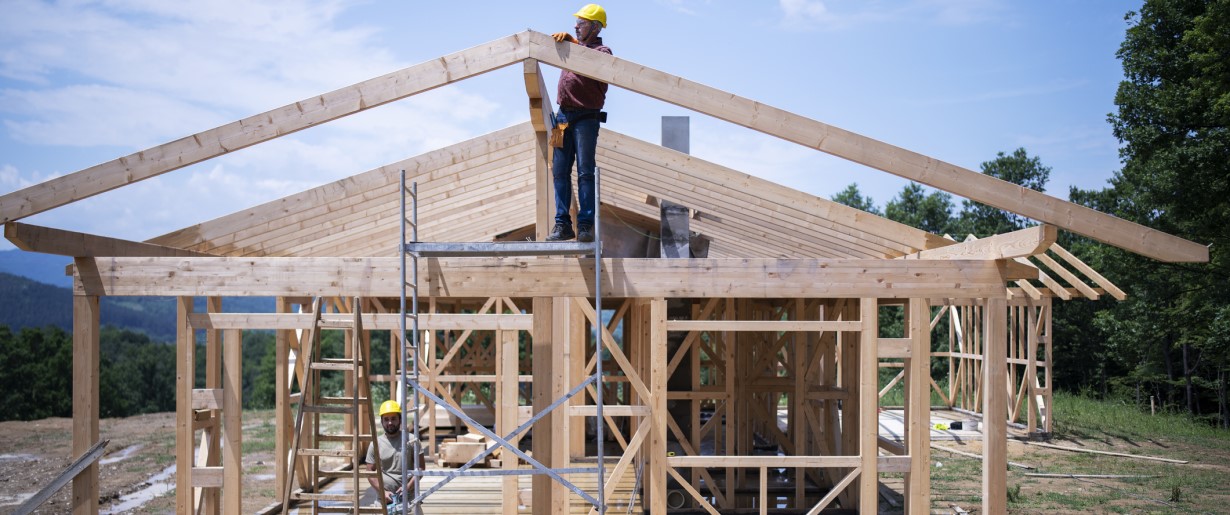
A Building Permit gives you legal permission to start a construction project and is required for construction, renovation or demolition of a building.

We need building permits to help make sure your project meets all zoning requirements, fire safety, and structural safety standards required by the Ontario Building Code and keep our community safe.

Do I Need a Permit for My Project?

Under the Building Code Act, you need a building permit for any new building, an addition, or alteration of any building or structure with a building area of over 10 square meters (approximately 108 square feet). With the exception of a shed which requires a permit for a building area over 15 square meters (approximately 161 square feet).

If you can't find your type of project below or if you have any questions, contact our Building Department.

Common Projects That Need a Building Permit

You need a building permit for:


New construction or additions

  • Any new building (residential, commercial, agricultural, industrial, or institutional)
  • Additions like a garage, carport, room, or second storey
  • Structural features such as a balcony, canopy, dormer, or enclosed porch
  • Accessory buildings or structures over 15 m² (161 sq. ft.) (e.g. shed, detached garage)
  • Excavating to add a new or full basement under an existing building


Decks

  • A deck attached to the house that is more than 24 inches (600 mm) above ground
  • Any deck that serves as the main entrance, regardless of size or height


Renovations or structural changes

  • Removing or altering load-bearing walls or partitions
  • Installing or replacing windows or doors that require structural changes
  • Finishing a basement with a bedroom or bathroom
  • Structural foundation repairs, drain tile replacement, or foundation damp proofing
  • Retaining walls over 1 metre tall on public property


Heating, plumbing, and other systems

  • Installing or replacing a wood stove, furnace, fireplace, or chimney
  • Installing or modifying plumbing systems (not just replacing fixtures)
  • Installing municipal water or sewer connections


Other projects

  • Installing a structural sign or tower
  • Installing solar panels on any building
  • Fabric-covered structures (any use)
  • Farm buildings such as barns, silos, storage buildings, or manure storage
  • Changing the use of a building (e.g. from residential to commercial)
  • Installing a new roof structure (not just replacing shingles)


If you can't find your type of project above or if you have any questions, contact our Building Department.

Projects That Do Not Need a Building Permit

You do not need a building permit for:

  • Demolishing a farm building (not including any home)
  • Buildings smaller than 15 m² (161 sq. ft.) with no plumbing
  • Building a freestanding deck (not attached to the house or any connected structure) with a walking surface less than 600 millimetres (24 inches) above ground
  • Adding drywall to basement walls to finish a recreation room
  • Replacing kitchen cabinets
  • Replacing plumbing fixtures (if not being relocated)

Booking Your Inspection

The required inspections for your project are listed on your building permit and can be discussed with the building department at any time if you are unsure when to book.

The permit holder is responsible to ensure all inspections are requested, the request can be made by the contractor or the permit holder. All requests must be sent by email to the Building Department and at least 48 hours notice is required. Inspections times tend to book up quickly so the more notice you give the more likely you are to have your inspection booked on your preferred day.

When requesting a building inspection please email the Building Department with the following information:

  • Your name
  • Permit number
  • Address of construction
  • Inspection being requested
  • Preferred date and time (either morning or afternoon)

Note that inspection times are approximate and morning inspections are between 8:30 a.m. and 11:30 a.m. and afternoon inspections are between 1:15 p.m. and 3:30 p.m. No one is required to be present for inspections that are outside a residence.

If you need to cancel a scheduled inspection please email the Building Department as soon as possible. According to By-Law 2025-150 a $230 reinspection fee may be imposed for inspections that are booked and not ready at the time of inspection. This does not typically apply if the inspection was thought to be ready but did not pass, the reinspection fee is more so related to inspections that were booked but not cancelled and not ready.

How to Apply for a Building Permit

 Steps
  1.  Complete the building permit application form.
  2. Ensure you have all required documents for your project (view section for more info).
  3. Email the Building Department with completed application and all required document at inspections@russell.ca.
  4. You will receive a confirmation email within 2 business days which will include an Application Number as well as the required Application Fee:
    • What is an Application Number? Application Number is the number given to you that will be associated with your eventual Building Permit.
    • What is an Application Fee? Application Fee is the required cost in order for your building permit application to accepted and processed. Application fees are based on the type of construction you are applying for and will be reduced from your final building permit fee. Application Fees are the base permit fee + refundable fee for the proposed project.
  5. Make the Application Fee payment to the Township of Russell, the application fee is noted in the email confirming receipt of your building permit application, always include your Application Number when making payment so that the Finance Department has a reference for the payment.
  6. Once your Application Fee payment is confirmed by the Finance Department and all items from your checklist are submitted, the building permit application will be entered into our permitting system and the review process will begin.
  7. Wait. Depending on the project and the time of year you are applying (busy season starts around April and ends around October) you will hear back from the Building Department with either questions and additional requirements or a notification of permit readiness.
  8. Receive email from Building Department confirming permit readiness as well as the total building permit fees owing. The total amount of building permit fees owing will include the reduction of the application fee amount.
  9. Make payment within 2 weeks of notice of readiness email.
  10. Building Permit Issuance, your signature will be required for the building permit.
  11. Start your construction Project and follow the required inspection schedule as noted on your building permit.

Building Projects

Learn about the application process, permit fees, inspections, and more for your project.

Addition to a Residential Building

Under the Building Code Act, a building permit is required for the construction of a new building, an addition, or alteration of any building or structure with a building area of over 10 square meters (approximately 108 square feet).

Here are examples of additions:

  • Sunrooms
  • Solariums
  • Attached Garages
  • Porches
  • One and two-storey additions

Document Checklist

  • Completed and signed Building Permit Application Form;
  • One set of construction plans and specifications;
  • Detailed site plan;
  • Approved water and sewer allocation form, if the addition is serviced by Public Utilities and an additional dwelling unit is being proposed;
  • Completed Mechanical Ventilation Summary sheet;
  • Septic permit from South Nation Conservation for a private sewage system if there are any additional bedrooms being added or if any plumbing is being added;
  • South Nation Conservation Approval if proposed construction occurs near a water course.
  • Septic permit from South Nation Conservation for a private sewage system (if applicable). 

Inspections

Inspections for an addition to a residential building
Inspection When the Inspection is Required

Service Inspection

Once service lines are installed in the trench and before covering the municipal service connections with any stone or material (if applicable).
Footing Inspection Before you pour the footings. You must provide a copy of the soil test from your geotechnical engineer before this inspection, you can email your report to the Building Department.
Underground Plumbing Inspection Before covering the underground plumbing with any material.
Backfill Inspection Before backfilling the foundation, once the dampproofing, weeping tile and stone coverage are installed
Framing Inspection Before insulation, you must have your plumbing, electrical, HVAC completed before this inspection. All Electrical work must be done through a permit from the Electrical Safety Authority.
Above Ground Plumbing Inspection Before insulation, an air or water test must be on for this inspection.
Insulation Inspection Before drywalling, insulation and vapour barrier must be installed.
Fire Resistance Rating Inspection Only applies in some cases and will be noted on your permit.
Final Inspection When all interior and exterior work is complete, and your building permit file can be closed.


Decks

  • Regardless of the deck's walking surface area, if the deck is adjacent to or attached to the house and its walking surface is more than 600 mm (24 in.) above the adjacent grade, a permit is required.
  • Regardless of the deck's walking surface area, if the deck is providing principal access to a building, a permit is required.
  • If the deck is independent from the house (not attached to the house or any other structure attached to the house) and its walking surface is less than 600 millimeters (24 inches) above the adjacent grade, a permit is not required.

The Ontario Building Code outlines the minimum requirements for various elements, such as joist size, beam size, foundation requirements, guard requirements.

Document Checklist

  • Completed and signed Building Permit Application Form;
  • One set of deck construction plans and specifications;
  • A detailed site plan;
  • South Nation Conservation Authority Approval, if your proposed project is near a water course;
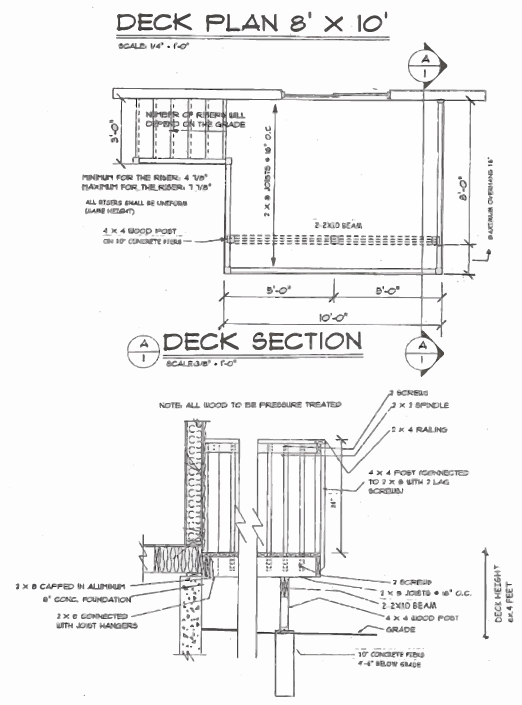
  • Engineering approval for techno metal post foundation systems or similar.Technical Drawing of a Deck Plan

Construction plans for a deck must be detailed enough that someone else could take them and build the deck without consulting with you. They can be done by a homeowner as long as all of the required information is on the plans. Deck plans must include information such as: what is the foundation system, size and spacing of foundation system, size and spacing of framing members, stairs, railings, guards, deck height, deck size etc. Some homeowners have used deck designer programs from retail stores or online programs and we can accept those plans for application submissions as well.


When Can I Use Deck Blocks?

Deck blocks are permitted to be used if the deck will not be attached to the house and when the underside of Joist is less than 24” above grade. The maximum spacing of deck blocks is suggested to be a maximum of 6’ unless otherwise specified by manufacturer.

What Size of Joists and Beams Do I Need?

If joists are spaced at 12 inches with bridging:

  • Wood Size 2 x 6 = Maximum Span of 10 feet, 4 inches
  • Wood Size 2 x 8 = Maximum Span of 12 feet, 5 inches
  • Wood Size 2 x 10 = Maximum Span of 14 feet, 6 inches
  • Wood Size 2 x 12 = Maximum Span of 16 feet, four inches

If joists are spaced at 16 inches with bridging:

  • Wood Size 2 x 6 = Maximum Span of 9 feet, 4 inches
  • Wood Size 2 x 8 = Maximum Span of 11 feet, 9 inches
  • Wood Size 2 x 10 = Maximum Span of 13 feet, 8 inches
  • Wood Size 2 x 12 = Maximum Span of 15 feet, 5 inches

Joist and beam spans are based on SPF Number 1 and 2 Grade. These tables are for reference only and spans will be checked to ensure they conform to the latest version of the Ontario Building Code.

Permitted Overhangs

  • 2 x 6 Joists: None
  • 2 x 8 Joists: 16” Maximum
  • 2 x 10 Joists: 24” Maximum
  • 2 x 12 Joists: 24” Maximum
  • Beams: 12” Maximum
 2-Ply Beams

If the Support Length (SL) is 8 feet, the requirements are:

  • 2-Ply Beam of 2 x 6 = 6’7”
  • 2-Ply Beam of 2 x 8 = 8’5”
  • 2-Ply Beam of 2 x 10 = 10’3”
  • 2-Ply Beam of 2 x 12 = 11’11”

If the Support Length (SL) is 10 feet, the requirements are:

  • 2-Ply Beam of 2 x 6 = 6’1”
  • 2-Ply Beam of 2 x 8 = 7’6”
  • 2-Ply Beam of 2 x 10 = 9’2”
  • 2-Ply Beam of 2 x 12 = 10’8”

If the Support Length (SL) is 12 feet, the requirements are:

  • 2-Ply Beam of 2 x 6 = 5’8”
  • 2-Ply Beam of 2 x 8 = 6’10”
  • 2-Ply Beam of 2 x 10 = 8’4”
  • 2-Ply Beam of 2 x 12 = 9’9”
3-Ply Beams

If the Support Length (SL) is 8 feet, the requirements are:

  • 3-Ply Beam of 3 x 8 = 9’1”
  • 3-Ply Beam of 3 x 10 = 11’8” 
  • 3-Ply Beam of 3 x 12 = 13’10”

If the Support Length (SL) is 10 feet, the requirements are:

  • 3-Ply Beam of 3 x 8 = 8’5”
  • 3-Ply Beam of 3 x 10 = 10’8”
  • 3-Ply Beam of 3 x 12 = 12’4”

If the Support Length (SL) is 12 feet, the requirements are:

  • 3-Ply Beam of 3 x 8 = 7’11”
  • 3-Ply Beam of 3 x 10 = 9’9”
  • 3-Ply Beam of 3 x 12 = 11’3”
Stairs and Handrail Design

Guards to conform to SB-7 of OBC. The Ontario Building Code states that stairs must have uniform risers and runs.

  • Minimum Rise of 4 7/8"
  • Maximum Rise of 7 7/8"
  • Minimum Run of 10"
  • Maximum Run of 14"


Inspections 

Inspections for a deck
Inspection When the Inspection is Required

Footing Inspection

Before you pour the footings. You may require a copy of a soil test from an engineer before this inspection depending on your design or a copy of the engineer approval for any techno metal posts or equivalent, you can email your report to the Building Department.
Framing Inspection This is before you cover the framing with decking or surround the deck with any enclosure. All beams and joists must be exposed and visible for the inspector. You may not have your stairs installed at this point, that is ok.
Final Inspection When the entire project is complete, and your building permit file can be closed. All stairs, railings and guards must be installed for the final inspection.


Demolitions

You need to obtain a building permit to relocate or demolish an existing building or structure. Your demolition application will be reviewed to ensure compliance with applicable law, including the Ontario Heritage Act and the Zoning By-Law.

The demolition of certain building types (silos, and barns) and non-load bearing interior partitions do not require a demolition permit.

Document Checklist

  1. Completed and signed Building Permit Application Form;
  2. Site plan indicating the location of the building being demolished;
  3. Engineer approval if the permit is to remove a structural supporting wall.

Inspections

Inspections for a demolition
Inspection When the Inspection is Required
Final Inspection When all demolition work is completed, and your demolition permit file can be closed.

Fence

You do not require a permit to build a fence on your property. Visit our Fences page for general rules to follow when installing a fence.

Finishing Your Basement or Renovating

If you are planning on finishing your basement you may require a building permit. No permit is required to install drywall to finish a recreation room or space other than for a bedroom. If a bathroom is being added or completed (even if the underground plumbing was already installed and inspected at the time of original construction) a building permit is required. A building permit is required to add a bedroom to your basement.

Document Checklist

  • Completed and signed Building Permit Application Form;
  • One sets of construction plans and specifications including room sizes, room uses and window and door sizes. Window “glazed” area must also be included on the plan;
  • A septic permit from South Nation Conservation for a private sewage system (if applicable).

Inspections

Inspections for finishing a basement or renovating
Inspection When the Inspection is Required

Underground Plumbing Inspection

Before covering the underground plumbing (if applicable). If the underground plumbing was already completed (with a permit) this inspection is not required.
Framing Inspection Before insulation, you must have your plumbing, electrical, HVAC completed before this inspection. All Electrical work must be done through a permit from the Electrical Safety Authority.
Above Ground Plumbing Inspection Before insulation, an air or water test must be on for this inspection (if applicable).
Insulation Inspection Before drywalling, insulation and vapour barrier must be installed.
Final Inspection When all construction work is completed, and your building permit file can be closed.

Garage or Accessory Building

Construction of an accessory building (detached garages and garden sheds), including prefabricated buildings, occupying an area greater than 15 square meters (161 square feet) requires a building permit. Prefabricated garages and sheds do require the same documents listed below. Ensure that the company you are purchasing the building from can provide detailed construction plans before you purchase the building.

Document Checklist

  1. Completed and signed Building Permit Application Form;
  2. One complete set of construction plans and specifications. If any plumbing is being added to the building and you are serviced by a private septic system approval from South Nation Conservation is also required.
  3. Layout from truss manufacturer for roof trusses;
  4. A detailed site plan;
  5. South Nation Conservation Authority Approval if proposed construction occurs near a water course
  6. A septic permit from South Nation Conservation for a private sewage system (if applicable).

Inspections

Inspections for garage or accessory building
Inspection When the Inspection is Required

Service Inspection

Before covering the municipal service connections (if applicable).
Footing Inspection Before you pour the footings or the slab on grade. You may be required to provide a copy of a soil test from an engineer before this inspection, you can email your report to the Building Department. A footing inspection is what would be required before pouring any concrete for a slab on grade as well.
Underground Plumbing Inspection Before covering the underground plumbing (if applicable).
Backfill Inspection Before backfilling the foundation (if applicable).
Framing Inspection Before insulation, you must have your plumbing, electrical, HVAC completed before this inspection. All Electrical work must be done through a permit from the Electrical Safety Authority.
Above Ground Plumbing Inspection Before insulation, an air or water test must be on for this inspection (if applicable).
Insulation Inspection Before drywalling, insulation and vapour barrier must be installed.

Final Inspection

When all interior and exterior work is complete, and your building permit file can be closed.

New Home

Document Checklist

  • Completed and signed Building Permit Application Form;
  • Schedule 1: Designer information form prepared by the designer;
  • One set of construction plans and specifications;
  • A copy of a detailed site plan or Survey;
  • Energy Efficiency Design Summary (EEDS), completed by the Designer;
  • Copy of the Deed of Land establishing title of the property;
  • TARION new home warranty program enrolment number (where required);
  • Completed Mechanical Ventilation Summary sheet;
  • Civic address application form, if not part of a subdivision;
  • Septic permit from South Nation Conservation for a private sewage system;
  • Approved water and sewer allocation if construction is serviced by Public Utilities;
  • Detailed grading plan for properties of less than one acre in area. May also be required at the discretion of the Chief Building;
  • South Nation Conservation Authority Approval if proposed construction occurs near a water course;
  • Entrance permit (culvert) from Public Works department (or the United Counties of Prescott and Russell when bordering a county road).

Only complete applications will be accepted, and we may ask for more information once we start reviewing your application.

Inspections

Inspections for a New Single Family Home
Inspection When the Inspection is Required

Service Inspection

Before covering the municipal service connections.

Footing Inspection

Before you pour the footings. You must provide a copy of the soil test from your engineer before this inspection, you can email your report to the Building Department.

Underground Plumbing Inspection

Before covering the underground plumbing.

Backfill Inspection

 Before backfilling the foundation.
Framing inspection A  Point load and truss inspection.
Framing inspection B Before insulation, you must have your plumbing, electrical, HVAC completed before this inspection. All Electrical work must be done through a permit from the Electrical Safety Authority.
Above Ground Plumbing Inspection Before insulation, an air or water test must be on for this inspection.
Insulation Inspection Before drywalling, insulation and vapour barrier must be installed.
Fire Resistance Rating Only applies in some cases and will be noted on your permit.
Occupancy Inspection Before anyone occupies (lives in) the dwelling.

Final Inspection

When all interior and exterior work is complete, and your building permit file can be closed.

Pool, Spa, or Hot Tub

A Swimming Pool Permit is required before you install a pool, spa, or hot tub on your property. See our Pool and Spa Permits page for the application process and requirements.

Secondary Dwelling Units (Adding an Apartment)

Adding a single, self-contained rental apartment to your home provides your family with an additional source of income and provides your community (or a member of your family) with another source of affordable housing. Even an “in-law suite” for your family members would require a building permit to ensure Ontario Building Code compliance.

Document Checklist

  • Completed and signed Building Permit Application Form;

  • Schedule 1: Designer information form prepared by the designer;
  • One set of construction plans and specifications;
  • A copy of a detailed site plan or Survey if an addition to the building is being proposed;
  • Septic permit from South Nation Conservation for a private sewage system that will have additional load due to the additional dwelling unit (1-877-984-2948 irwww.nation.on.ca);
  • Approved water and sewer allocation if construction is serviced by Public Utilities;

Only complete applications will be accepted, and we may ask for more information once we start reviewing your application.

Inspections

Inspections for a Secondary Dwelling Unit
Inspection When the Inspection is Required

Underground Plumbing Inspection

Before covering the underground plumbing.

Framing Inspection

Before insulation, you must have your plumbing, electrical, HVAC completed before this inspection. All Electrical work must be done through a permit from the Electrical Safety Authority.

Above Ground Plumbing Inspection

Before insulation, an air or water test must be on for this inspection.

Insulation Inspection

Before drywalling, insulation and vapour barrier must be installed.
Fire Resistance Rating When your fire separation components are visible to the inspector, this may require multiple inspections

Occupancy Inspection

Before anyone occupies (lives in) the new dwelling

Final Inspection

When all interior and exterior work is complete, and your building permit file can be closed.

Septic System

Property owners are responsible for all installation, maintenance, and repairs of the private well and septic tank on their land. Please refer to our Septic Tanks and Private Wells page for more information.

Woodburning Appliances and Wood Stoves

A building permit is required for the installation of a:

  • Masonry fireplace /masonry chimney
  • Woodstove and chimney
  • Pellet stove (wood, corn, grain, etc.)
  • Fireplace insert /chimney liner
  • Pre-manufactured fireplace and chimney

Document Checklist

  • Completed and signed Building Permit Application Form;
  • Manufacture's specifications of the proposed unit;
  • Sketch of where in the building the appliance will be installed.

Inspections

There are no inspections required by the Township of Russell, however, an inspection by a WETT Certified person is required. It is the permit holder’s responsibility to obtain the required compliance report.

Fees

View Application Fee Calculations and Building Permit Fee Schedules

Additional Fees

In addition to the building permit fees listed for each project type above, Development Charges may also apply. Contact our Building and Planning Department for more information. Request a copy of our Building Permit Fees By-Law by contacting our Building Department.

Timelines

The application process and timeline will depend on how complex your project is, and whether all required information is provided in your application submission. Refer to the checklist related to your project before submitting your application.

Other Information

What is a Construction Plan?

Construction Plans

To submit construction plans, you need to include:

  • All structural framing (walls and materials), floor system layout (beams, joists, etc);
  • Roof truss layout with all dimensions and specifications;
  • Elevations of all facades (Front, Rear, Right, Left);
  • Exterior finishes, windows, door type, roof slope and finish, stairs, landings, guards & handrails;
  • Footings and foundation wall details. Specifications of all floors, wall and roof assemblies. Typical cross sections;
  • Engineers approval may be required;
  • If the proposed on-ground slab is more than 55m2 (592ft2) engineering approval is necessary for the design;

Only complete applications will be accepted. We may need additional information once we start reviewing your application.

What is a Site Plan?

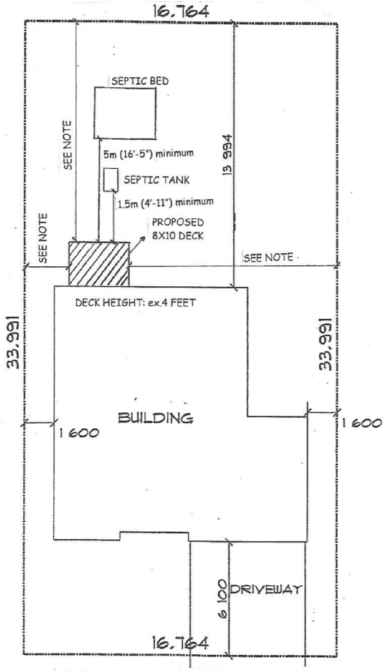
A site plan is a sketch of the property that shows the location of your project and how close it is to the property lines. If you have questions about your site plan, please contact the Planning Department.

Technical Drawing of a Site Plan

What should the site plan include?

  • Dimensions and area of the lot and its legal description of address
  • Location of existing and proposed easements
  • Location of road boundaries, private or public streets, and dimensions
  • Location, dimensions and area of building in relation to the building lot
  • Setbacks between each building and property lines
  • Location of streams, ditches or substantial differences in grade on land
  • Distance between all structures and septic tank and septic bed

The above list is only a guide to assist you to prepare your site plan. Please confirm with our Building and Planning Department before submitting your site plan.